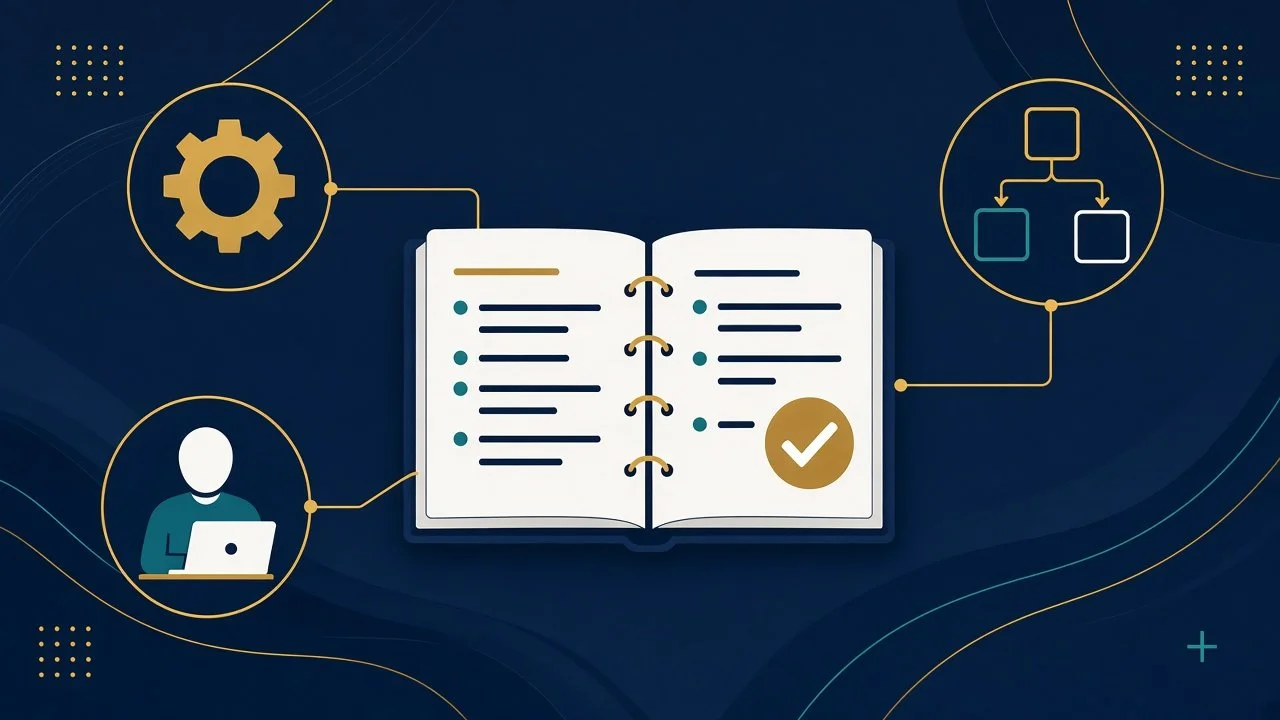
A customer asks a question and your team says, "Let me check with the owner." A new hire spends their first week guessing. A task gets done three different ways depending on who's working that day.
None of that is a people problem. It's a documentation problem. When the way work gets done only lives in your head, every question routes back to you, and the business can't scale if everything runs through you.
Standard operating procedures fix that. This guide covers how to write standard operating procedures (SOPs) for a small business: what an SOP is, which processes to document first, a 7-step writing process, a fill-in SOP template and the mistakes that make SOPs gather dust.
What Is a Standard Operating Procedure (SOP)?
The U.S. Environmental Protection Agency's Guidance for Preparing Standard Operating Procedures offers a clear definition: "A Standard Operating Procedure (SOP) is a set of written instructions that document a routine or repetitive activity followed by an organization."
That guide was written for quality systems, but the idea applies to any business. An SOP answers three questions for whoever is doing the work:
- What is this task and what does "done" look like?
- Who is responsible for it?
- How is it done, step by step, every time?
An SOP isn't a policy (the rule) or a job description (the role). It's the playbook for one repeatable task, such as onboarding a new client, sending an invoice or publishing a social post.
Why SOPs Matter for a Growing Small Business
Written procedures do more than keep things tidy. For a small business, they are what makes growth possible:
- Consistency. Customers get the same quality whether you do the work or someone on your team does.
- Faster onboarding. New hires and contractors learn from a document instead of shadowing you for weeks.
- Real delegation. You can hand off work without handing off the worry, which is the core of why delegating feels risky for so many owners.
- Fewer bottlenecks. Questions get answered by the SOP, not by interrupting you.
- A more valuable company. Documented processes are part of the business systems that support scaling, and they make your business less dependent on any one person.
The EPA guidance adds a warning worth remembering: "the best written SOPs will fail if they are not followed." Writing SOPs is step one. Getting your team to use them is the real goal.
Which Processes Should You Document First?
You don't need an SOP for everything on day one. Start with the processes that cost you the most time or cause the most mistakes. A quick way to prioritize is to list your weekly tasks and flag any that are:
- Repeated often (daily or weekly tasks like order processing, scheduling or bookkeeping entries)
- Customer-facing (sales calls, client onboarding, support replies)
- Error-prone (billing, payroll prep, compliance filings)
- Blocking a hire or handoff (anything you want to outsource first when scaling)
- Only known by one person (if they're out sick, the work stops)
Pick three to five processes that hit two or more of these. Those are your first SOPs.
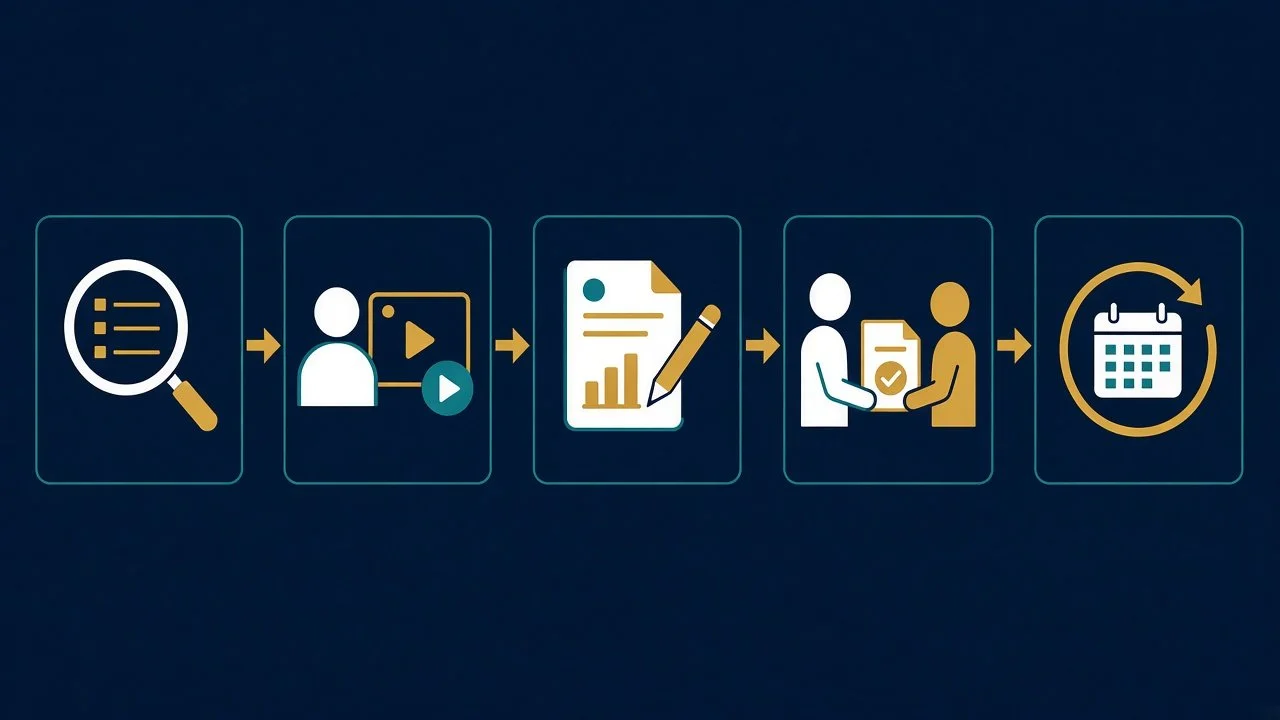
How to Write Standard Operating Procedures: A 7-Step Process
Step 1: Define the scope and the outcome
Write one or two sentences on what the procedure covers, where it starts and where it ends, and what a finished result looks like. "Client onboarding: from signed agreement to first kickoff call" is a clear scope. "Client stuff" is not.
Step 2: Capture how the work is done today
Before you write anything, watch the process happen. Record your screen while you do the task, talk through it out loud, or have the person who does it best walk you through it. You're documenting reality, not the ideal version you imagine.
Step 3: Choose the right format
Match the format to the task:
- Checklist for simple, routine tasks where order matters less than completeness
- Numbered steps for linear tasks that must happen in sequence
- Flowchart for tasks with decisions or branches ("if the client pays by check, do X; if by card, do Y")
The EPA guidance notes that "use of diagrams and flow charts help to break up long sections of text and to briefly summarize a series of steps for the reader." Screenshots and short screen recordings work well for software tasks.
Step 4: Write the steps clearly
The EPA guide (PDF) recommends that SOPs "be written in a concise, step-by-step, easy-to-read format" and that "the active voice and present verb tense should be used." In practice:
- Start each step with an action verb: "Open," "Send," "Confirm," "Save."
- Keep one action per step.
- Name the exact tool, folder, template or login location.
- Define any terms a new person might not know.
- Write for someone smart who has never done this task before.
Step 5: Add owners, inputs and quality checks
Every SOP should say who owns the task, what they need before they start (files, access, information) and how they know it was done right. A short "quality check" at the end, such as "confirm the client received the welcome email," catches problems before customers do.
Step 6: Test it with someone else
This is the step most owners skip. The EPA guidance says it plainly: "It is especially helpful if draft SOPs are actually tested by individuals other than the original writer before the SOPs are finalized." Hand the draft to a team member or contractor, have them follow it without help, and note every spot where they get stuck. Then fix the document, not the person.
Step 7: Publish, train and schedule reviews
Store SOPs in one shared place your team already uses, with a consistent naming system. Walk the team through new SOPs, and set a review date. The EPA guidance suggests SOPs be "systematically reviewed on a periodic basis, e.g. every 1-2 years." For a fast-moving small business, reviewing key SOPs whenever a tool, price or process changes is a practical rule.
A Simple SOP Template You Can Copy
Use this outline for each procedure. Keep it as short as the task allows.
SOP title: Clear name of the task (for example, "Send a Monthly Client Invoice")
SOP number and version: A simple ID (OPS-004) · version number · last reviewed date
Purpose: One sentence on why this task matters
Scope: Where the process starts and ends, and what it doesn't cover
Owner: The role responsible (use a role, not just a name, so the SOP survives staff changes)
Tools and access needed: Software, logins, templates, folders
Steps:
- Action verb + exact instruction
- Action verb + exact instruction
- Decision point: if X, go to step 4; if Y, go to step 6
Quality check: How to confirm the task was done correctly
Related SOPs and forms: Links to checklists, templates or the next process in the chain
Revision history: Date · what changed · who approved it
Using SOPs to Delegate to Your Team and Virtual Staff

SOPs are what make delegation stick, especially with remote team members. A virtual assistant or offsite specialist can't tap you on the shoulder with a quick question, so a clear SOP becomes their manager for that task.
A simple handoff routine looks like this:
- You document the process using the steps above.
- They run it while you review the first few results.
- They improve it, updating the SOP when they find a better way, with your approval.
- You step back and check results with a weekly metric instead of watching every task.
This is the same approach we cover in our guide to virtual staffing for small business: the companies that get the most out of outside help are the ones that hand over clear processes, not vague requests. If you want trained support to take documented work off your plate, see LGS Virtual Staffing.
If you're hiring employees rather than contractors, the SBA's hire and manage employees guide covers the legal and tax basics to handle alongside your onboarding SOPs.
Common SOP Mistakes to Avoid
- Writing a novel. Long, wordy SOPs don't get read. The EPA guidance puts it simply: "Keep it simple and short."
- Documenting the ideal instead of reality. If the SOP doesn't match how the work is really done, people ignore it.
- Skipping the test. If only the writer has followed it, you don't know whether it works.
- No owner. An SOP with no owner goes out of date fast.
- Scattering documents. SOPs spread across email, desktops and chat threads might as well not exist. Keep one home for them.
- Never updating. A wrong SOP is worse than none. Update it whenever the process changes.
- Trying to document everything at once. Start with three to five high-impact processes and build from there. Growth without systems is chaos, but systems get built one process at a time.
Frequently Asked Questions
What is the difference between an SOP and a process?
A process is the work itself, the series of activities that turns an input into a result. An SOP is the written instructions for carrying out that process the same way every time.
How long should an SOP be?
As short as it can be while still letting a new person do the task correctly. Many small business SOPs fit on one or two pages. If one runs much longer, consider splitting it into smaller procedures.
What format is best for an SOP?
Use a checklist for simple routine tasks, numbered steps for tasks that must happen in order, and a flowchart for tasks with decision points. Screenshots or short videos help for software tasks.
Who should write SOPs in a small business?
The person who does the task best should help capture it, and the owner or manager should approve it. Then have someone else test the draft before it's final.
How often should SOPs be updated?
Review key SOPs whenever a tool, price, regulation or process changes, and give every SOP a scheduled review date. The EPA's guidance offers "every 1-2 years" as an example of a periodic review cycle.
Where can I get free help building business processes?
The SBA's Manage your business guide is a solid starting point, and SBA resource partners such as Small Business Development Centers offer counseling. Use the SBA's local assistance finder to find help near you.
Build Systems That Run Without You
SOPs turn what you know into something your team can repeat. Start small: pick three processes this week, record how they're done, write them up with the template above and have someone test them.
If you want help mapping your processes, building out operating systems or staffing the work once it's documented, LaNasa Global Solutions works with founders and small business owners on business consulting, operations and virtual staffing. Explore our services, grab our Free Business Road Map, or book a 30-minute service Q&A to talk through where your business is getting stuck.
This article is general information about business operations and is not legal, tax or financial advice. Employment, contractor and industry-specific compliance requirements vary, so consult a qualified professional for your situation.